pdf drawing to 3d model
Convert PDF to 3D SolidWorks Model
About SolidWorks
SolidWorks is a powerful 2D and 3D CAD program that has seen extensive use with digital drafters all effectually the globe. In 2016, Dassault Systèmes reported 2.three million active users in more than 230,000 companies and lxxx different countries and that number has merely continued to grow.
A lot of its popularity comes from its intuitively easy interface and plan workflow. It employs a " top-downwards " approach in design – the user starts with a 2nd sketch oriented on a starting plane and and so proceeds to sculpt a 3D model out of the initial 2D geometry. The program's list of 2nd and 3D sketch tools is extensive, with CAD standards such as lines, splines, arcs, and circles and all the typical 3D modeling tools as well.
Thinking and designing in 2nd kickoff before working on the 3D model helps drafters think about precise measurements and proportions more easily and more than thoroughly. Ideally, users will have editable CAD files to work with when converting second into 3D but most drafters will understand the frustration of how, at times, all you accept to work with as reference are customer-sent PDF files.
PDF files are created for the meaty sharing of documents and drawings. Information technology'due south a file format that mostly but Adobe programs can readily edit. Every bit such, PDF files are non easily editable in-plan within SolidWorks and that difficulty merely gets worse when you consider how a lot of PDF files contain raster images rather than vector information. So what are our options and how do nosotros proceed?
Permit'due south take a look at how PDF to 3D SolidWorks model processes work and what our best course of action tin can be.
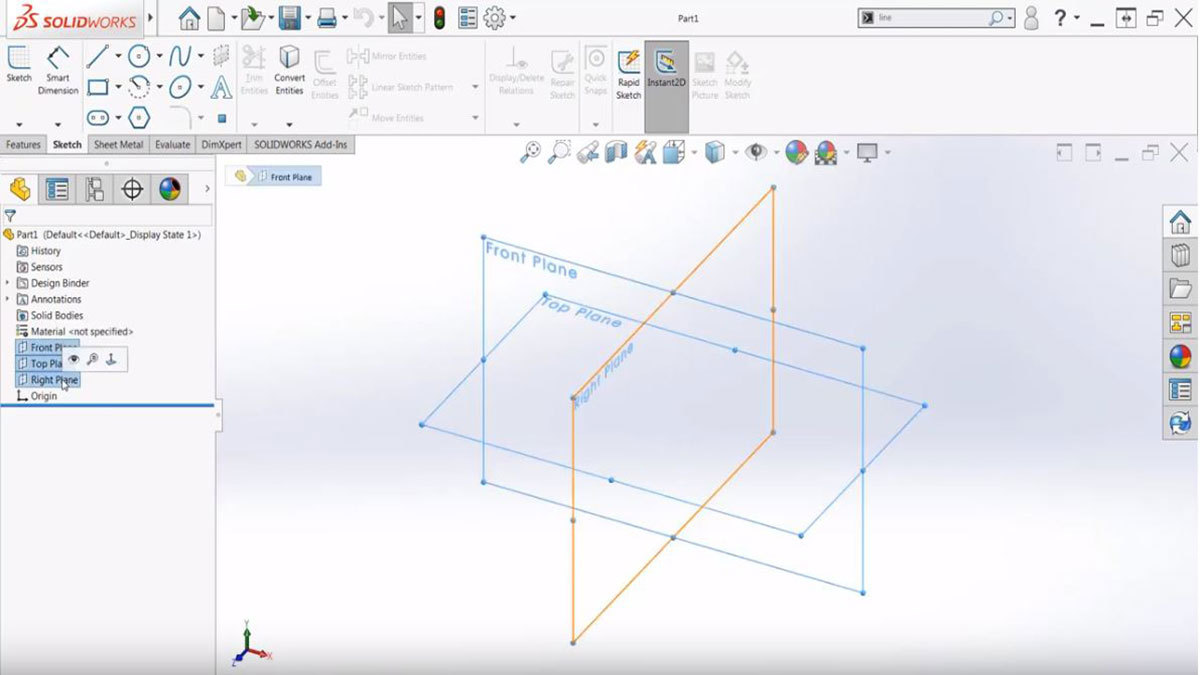
The basic SolidWorks work interface Source
On importing images
SolidWorks can handle importing most of the common prototype file formats as follows:
| 2D Paths | – AI (Adobe Illustrator) – DWG (Cartoon) – DXF (Drawing Interchange/Commutation Format) |
| 3D Mesh | – STL – WRL (VRML) |
| 3D Solids | – .x_t (Parasolid) – IGS, IGES – Saturday (ACIS) – STP, STEP |
| CAD and Vector | – ASM (Pro/E Assembly) – ASM (Solid Edge Associates) – IAM ( Inventor Associates) – IPT (Inventor Office) – PRT (Pro/E Part) – PRT (Unigraphics) – PRT, CKD (CADKey) – PSM (Solid Edge Part) |
| Sketch Picture | – BMP (Bitmap) – GIF (Graphic Interchange Format) – JPG, JPEG (Joint Photographic Experts Group) – PNG (Portable Network Graphics) – PSD (Adobe Photoshop Document) – TIF, TIFF (Tagged Paradigm File Format) – WMF (Windows Metafile) |
| Special Files | – CATIA Graphics – IDF, EMN, BRD – IFC – Indicate Cloud Files – Rhino Files – VDA (VDAFS) |
As extensive as the list may be, PDF is not 1 of the native file types that SolidWorks can handle. In that location are, still, some workarounds which we'll get into shortly.
Clarity is the number ane factor in considering reference images to utilise. This determines how authentic our concluding product volition exist and how easily we are able to achieve our end goals. A 3D model made from pixelated, askew, poorly-scaled 2D reference files will most certainly be subpar for most professional settings. So the first stride is making sure we have the best possible starting point with the best possible version of the reference epitome.
Once you have a clear image, the nearly straight-frontwards manner of converting it into editable SolidWorks elements is to only trace over information technology. For simpler images, SolidWorks fifty-fifty has an automatic tracing function that aims to trace over the sold lines of the epitome. Practice note that this may not be the most platonic solution since the automatic tracing leaves some to exist desired when it comes to make clean, authentic output. So if you do want to use Solidworks' automated tracing, go on in mind that information technology's only suitable for simple line images with plenty of room for inaccuracies.
-
-
YOU MIGHT Besides Like:
How To Trace An Image In SolidWorks
With more complex technical drawings, users will typically use Solidworks' second CAD tools to trace over the lines in the image, similar to how transmission drafters would replicate drawings by using tracing newspaper and transmission drafting tools.
Although this method is authentic and is express only by the user's comprehension of the original image, information technology is not the fastest method and certainly not the easiest to do. Luckily, there are diverse third-party programs such as Scan2CAD that specialize in raster-to-vector conversion and tin practice and then with much better results that any CAD program's automatic tracing functions. These programs can convert your raster PDF'due south into readily editable vector files that you lot can plop into SolidWorks and work with without having to do a lick of digital trace-over.
Raster vs. Vector
Nosotros've been covering a lot of footing on how importing images into SolidWorks works then far and a lot has been mentioned most raster and vector images. Let'due south take a quick refresher on what the differences between the two image types are.
Raster images, likewise known as bitmap images, consist of clustered colored pixels that form a coherent epitome. Most of the more well-known image file types are raster formats such every bit .jpeg, .png, and even .gif. Raster images are static, uneditable image types with quality that depends on the file size and number of pixels in the image.
Vector images, on the other hand, are fabricated of formulas and data that are then digitally converted into images. A vector image of an arc, for instance, is actually a file containing data that dictates the arc's radius, line length, color, thickness, etc. Editability is this file blazon'southward strong suit since information technology isn't constrained by pixel number or quality and can be readily opened and inverse by whatsoever vector-editing program.
-

-
YOU MIGHT ALSO Like:
Explained: Raster versus Vector
PDF files are catchy to work with since they can comprise both raster and vector information. Information technology's easy to sympathise why we would prefer vector PDFs to raster PDFs but what do we practice when the file has both? We'll embrace what to practice in that state of affairs and more in this article.
Converting a PDF using SolidWorks tools
When all is said and done, uploading a PDF paradigm to trace and model in SolidWorks is a straight-frontwards and simple process. Information technology might require some workarounds since the program can't natively handle PDF files, but the process as a whole is easy to empathize.
- The offset thing y'all'll want to exercise is get a workable file format out of the PDF y'all desire to use as a reference prototype. Both modern Macs and PCs accept built-in screenshot tools you'll want to take reward of. Even if your machine doesn't accept that, at that place are plenty of free screen capture programs you can download and employ.
Take a screenshot of the part of the PDF yous desire to employ equally a SolidWorks reference and salve information technology in a file format that the software can handle. From this point on, you won't have to worry about the PDF anymore and but utilize the saved screenshot as your image reference.
- On SolidWorks, effigy out the plane you want to be sketching in. If the prototype is a top-downwards view, choose the Acme plane. If it'southward a sideways view, cull either the Right or Left planes and choose the Forepart plane if it's a front end view. Click on the aeroplane on the left side of the screen and create a sketch.
- Under the Tool carte du jour, choose Sketch Tools > Sketch Pic. On the dialog box that pops upward, browse for your reference epitome and open it upward on your chosen plane.
- Y'all'll desire to do a final resizing and cropping of the reference photograph earlier you start sketching. It's always best to exercise this at the beginning so yous don't have to go through the trouble of correcting your sketch size later on on.
- From here on out, it's but a matter of tracing over the prototype with SolidWorks' sketch tools and then using the corresponding trace to create a 3D model. Information technology's a unproblematic process simply becomes a tedious task if the reference epitome in question is big enough or complex enough as a reference drawing.
Converting a PDF to SolidWorks
If yous e'er find yourself in demand of a conversion program for PDF files, a quick Google search volition net yous with pages upon pages of results for online conversion tools. With almost all of these results, the quality of the output you're getting is only downright subpar. If you're lucky enough to detect one that produces something decent, y'all'll probably be dealing with watermarks or partial conversions. Another consequence to consider is the sheer corporeality of privacy risks you're taking with uploading or emailing your PDF documents for conversion.
If you're dealing with a low-risk, one-time conversion, this might be good enough for you. But for anything more, your best option would accept to be specialized desktop programs such as Scan2CAD.
Stride i: Convert the PDF
Programs similar Scan2CAD volition normally crave a buy or subscription, but if yous're dealing with repeated PDF conversions for work, the program volition eventually pay for itself. Scan2CAD specifically even has a 14-mean solar day free trial period for yous to endeavour and see if the plan is worth the payment. There simply isn't a better solution if you're looking for a reliable, consequent, quality conversion program.
So allow'southward have a look at the step-by-step process of using Scan2CAD to convert your PDFs into usable file formats for SolidWorks.
- Open up up the reference PDF file y'all want to use on Scan2CAD. A dialog box will open up that volition display both the raster and vector elements in the document. Unfortunately, if the document has both elements and yous need both the raster and vector elements equally references, you'll have to convert and save both individually.
- For raster data: Using the Clean prototype option, turn the raster paradigm monochromatic and make clean information technology up until you lot're satisfied. Continue to convert the raster image into vector data and salve information technology equally a usable vector file that you can and then edit on SolidWorks.
For vector data: Simply open up the vector data and so save information technology as a workable file type.
We accept plenty of data on these processes in the form of tutorials and articles if you desire to learn more about how to use Scan2CAD.
Step 2: Import into Solidworks
- Open up up the now workable vector file and utilise that as an editable reference on SolidWorks.
Hither's a quick video to detail that process:
Source: https://www.scan2cad.com/blog/cad/pdf-dwg-solidworks-model/
0 Response to "pdf drawing to 3d model"
Post a Comment